

Groundnut, commonly known as peanut (Arachis hypogaea), is one of the most important food and cash crops cultivated across Africa. Although the crop originated in South America, particularly in present-day Brazil and Paraguay, it was introduced to Africa by Portuguese traders during the 16th century. Over time, groundnut adapted well to the continent’s tropical and semi-arid climates, becoming a major agricultural commodity and an important source of livelihood for millions of people.
Today, countries such as Nigeria, Senegal, Sudan, Niger, and Ghana are among Africa’s leading groundnut producers, with Nigeria ranking as one of the largest producers on the continent. The crop remains central to food security, rural employment, nutrition, agro-processing, and trade. Its importance goes beyond farming; it supports an entire value chain involving seed suppliers, farmers, transporters, processors, traders, exporters, and manufacturers.
In Nigeria, groundnut production plays a vital role in the agricultural sector. The crop is rich in protein, healthy fats, vitamins, and minerals, making it an important source of nutrition for households across the country. Historically, the famous Groundnut Pyramids of Kano stood as a powerful symbol of Nigeria’s agricultural strength and export capacity during the 1960s and 1970s. Although the sector later declined due to changing economic priorities, inadequate investment, and challenges in production systems, groundnut remains one of Nigeria’s most promising agricultural commodities.
The production cycle begins with planting, usually at the onset of the rainy season. Farmers select quality seeds and plant them in well-drained sandy loam soils with adequate sunlight. In many parts of northern Nigeria, where groundnut is predominantly grown, planting often takes place between May and June, depending on rainfall patterns. Proper land preparation, seed selection, spacing, and timely planting are essential for healthy crop development and improved yields.
Cultivation requires regular farm management practices such as weeding, pest control, disease management, and soil fertility improvement. As a leguminous crop, groundnut has the natural ability to fix nitrogen in the soil, thereby improving soil fertility and reducing dependence on chemical fertilizers. Farmers often rotate groundnut with cereals such as maize, millet, and sorghum to enhance soil productivity and reduce pest and disease pressure. With improved seed varieties, better agronomic practices, irrigation support, and access to extension services, farmers can significantly increase productivity and profitability.
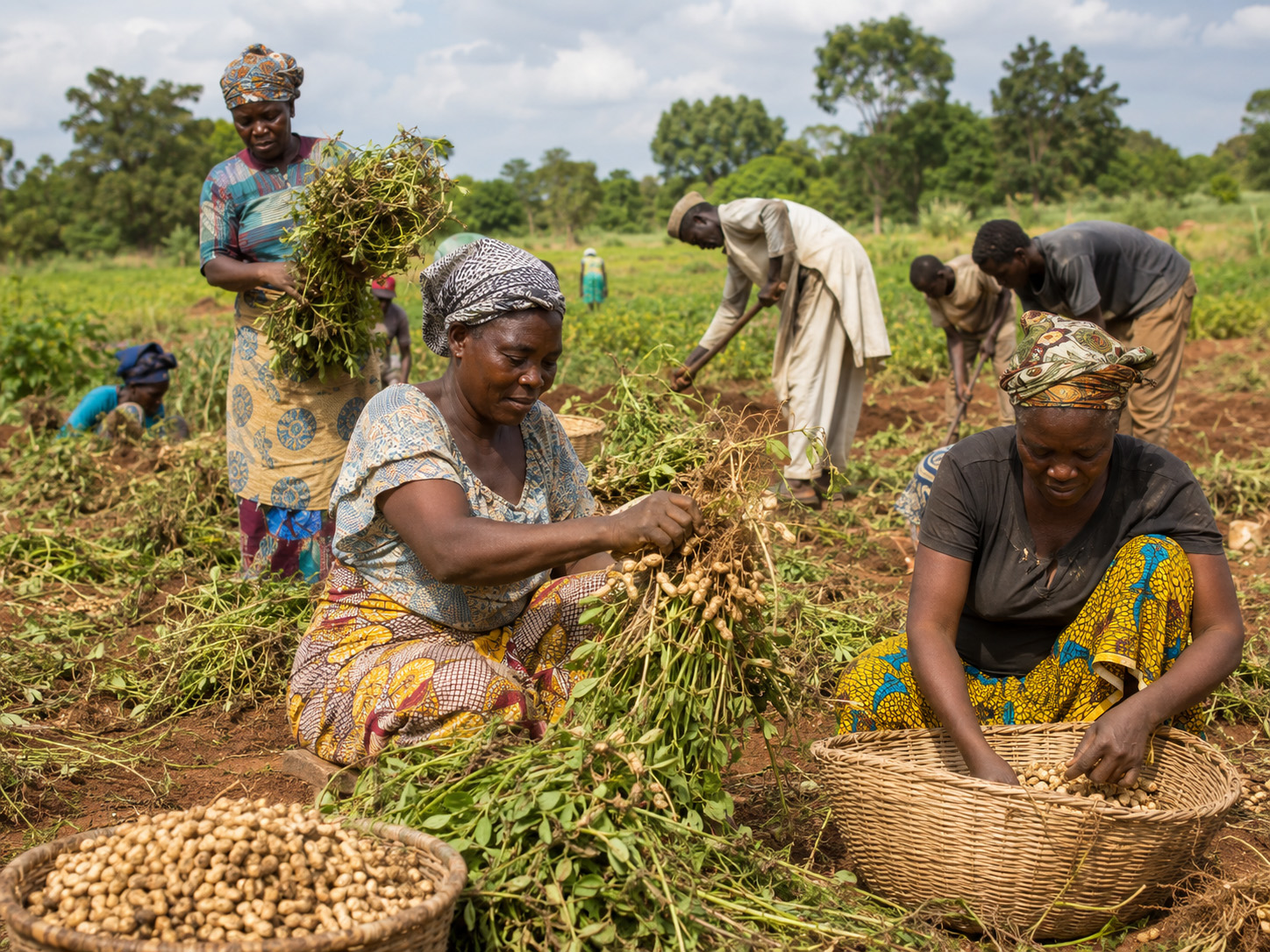
Harvesting usually takes place between 90 and 150 days after planting, depending on the variety and environmental conditions. Farmers determine maturity when the leaves begin to yellow and the pods are fully developed beneath the soil surface. Harvesting is often done manually by uprooting the plants and shaking off excess soil. Proper harvesting is important because poor handling can lead to losses, pod damage, contamination, and reduced market value. After harvesting, the pods are dried properly to reduce moisture content before storage or processing.
Processing adds significant value to groundnut production and creates opportunities for agro-industrial development. After harvesting, the nuts are cleaned, shelled, graded, and processed into various products. Groundnuts can be crushed to produce edible oil, while the residue, known as groundnut cake, is widely used as livestock feed. Improved processing facilities help increase product quality, reduce post-harvest losses, extend shelf life, and improve competitiveness in both local and international markets.
Groundnut products are diverse and widely consumed across Africa and beyond. They include roasted peanuts, peanut butter, cooking oil, flour, snacks, confectioneries, animal feed, and industrial raw materials. The crop serves multiple sectors, including food manufacturing, livestock production, pharmaceuticals, and cosmetics. As demand for processed and value-added agricultural products continues to grow, groundnut offers major opportunities for entrepreneurs, processors, exporters, and investors.
Economically, groundnut production contributes substantially to Africa’s agricultural economy. In Nigeria, millions of smallholder farmers depend on the crop for income, employment, and household stability. Depending on farm size, management practices, access to inputs, yield levels, and market conditions, groundnut farming can generate meaningful income for both small-scale and commercial producers. Beyond direct cultivation, the crop supports job creation in processing, transportation, packaging, marketing, and export.
However, the sector still faces challenges. These include low mechanization, limited access to improved seeds, inadequate storage facilities, post-harvest losses, pest and disease attacks, poor market linkages, and limited access to finance. Addressing these challenges requires coordinated investment from governments, development partners, private investors, research institutions, and farmer cooperatives.
With increased investment in improved seed varieties, mechanization, irrigation, storage, processing, market access, and farmer training, groundnut production can become a stronger driver of sustainable agricultural development. It has the potential to create jobs, strengthen food security, increase export earnings, empower rural communities, and contribute to industrial growth across Nigeria and Africa.
Groundnut is therefore more than a traditional crop. It is a strategic agricultural resource with the capacity to support nutrition, enterprise, rural development, and economic transformation. If properly developed, the groundnut value chain can help reposition African agriculture from subsistence production to sustainable wealth creation.