

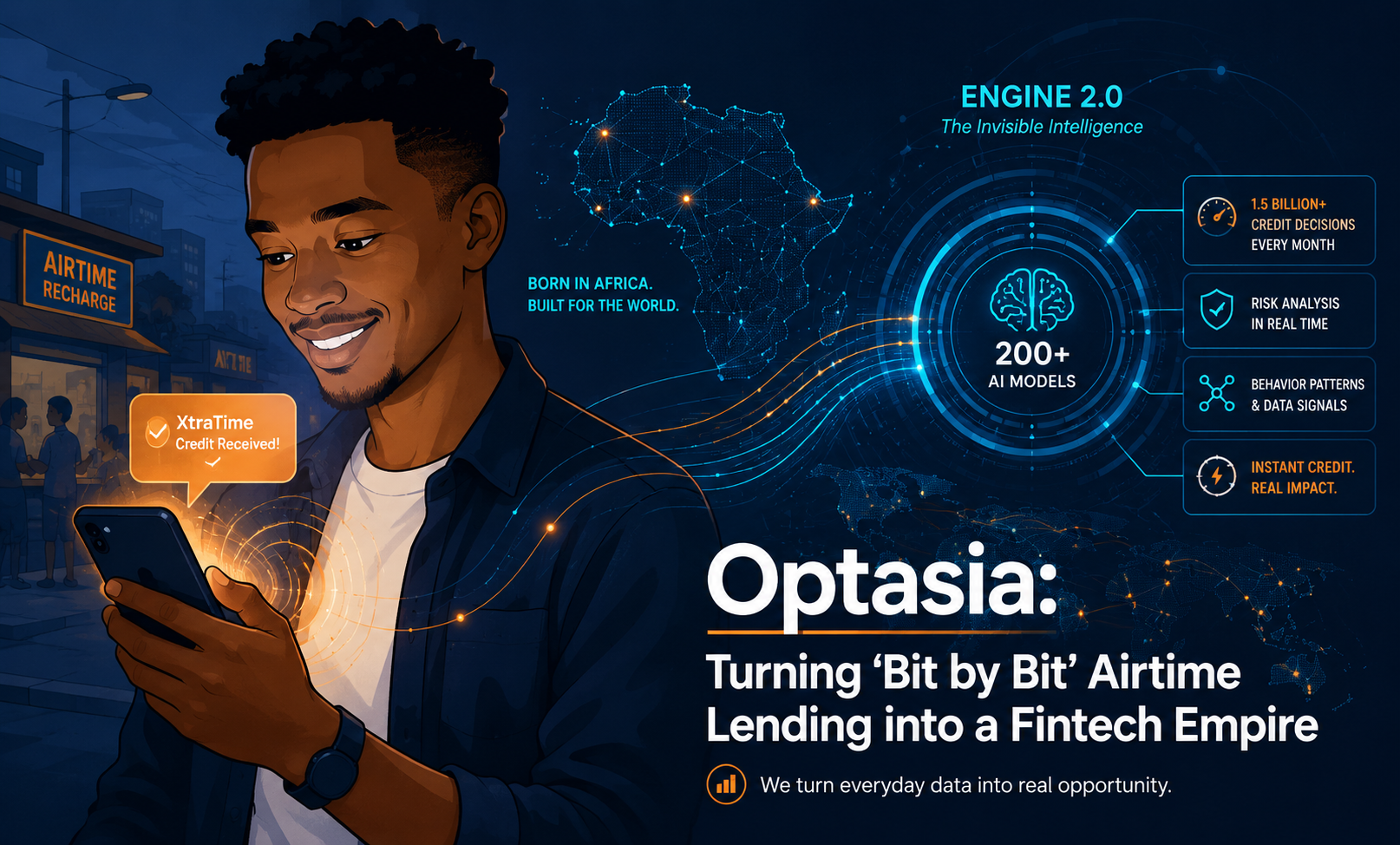
Imagine being in the middle of an urgent phone call when the line suddenly goes dead. Your airtime has finished. There is no recharge vendor nearby, no cash in hand, and no immediate way to reconnect. For some people, this may be a minor inconvenience. For millions of people in emerging markets, it can be a real barrier to communication, business, and economic participation.
This is the simple but powerful problem that Optasia identified and transformed into a major fintech opportunity. What may appear ordinary at first glance, lending small amounts of airtime to stranded mobile users, has become a sophisticated technology driven business model. Bit by bit, Optasia has shown how artificial intelligence, mobile data, and strategic partnerships can bridge the gap between formal finance and consumers who have long remained invisible to traditional banking systems.
Seeing What Traditional Banks Missed
For decades, traditional banks overlooked hundreds of millions of people across Africa, Asia, and the Middle East because they lacked formal credit histories, regular salaries, collateral, or access to conventional financial documentation. To the banking sector, these consumers were often considered too risky, too informal, or too costly to serve.
Optasia, formerly known as Channel VAS, saw something different. The company recognized that while many people did not have formal bank accounts, they did have mobile phones. Across many emerging markets, mobile phone usage has become one of the strongest signs of daily economic activity. People recharge, make calls, buy data, send messages, and interact digitally even when they remain outside formal financial systems.
This was the opening Optasia identified. Mobile usage data, when properly analysed, can become a form of alternative credit history. Every recharge, every call, every data purchase, and every pattern of mobile activity leaves behind a digital footprint. Optasia’s founder, Bassim Haidar, and his team understood that these footprints could be used to predict whether a user was likely to repay a small airtime advance.
In other words, the company did not wait for customers to become visible to traditional banks. It built a way to see them differently.
The Power of Artificial Intelligence
The true strength of Optasia’s model is not simply the airtime loan itself. It is the speed, intelligence, and scale of the decision making that happens behind the scenes. Through its proprietary Engine 2.0 platform, Optasia analyses thousands of unstructured data elements and transforms them into meaningful user insights.
Instead of asking for a payslip, bank statement, or collateral, the system studies recharge patterns, spending behaviour, transaction history, usage frequency, and other indicators of reliability. Its artificial intelligence models process vast amounts of information in real time, allowing the system to make lending decisions almost instantly.
This is where the model becomes remarkable. Optasia reportedly processes about 1.5 billion credit decisions every month. Its technology learns continuously, identifies eligible users, manages risk, and enables very small loans to be issued profitably. Even though many of these users would be considered high risk by traditional banks, the company has been able to keep default levels relatively low through predictive technology and data driven scoring.
The lesson is clear. Financial inclusion is not always about building more physical banks. Sometimes, it is about using technology to recognise value where old systems saw only risk.
Building Seamless Partnerships
A strong algorithm alone is not enough. To reach customers at scale, Optasia needed access to the platforms people already use every day. The company achieved this by forming strategic partnerships with mobile network operators such as MTN, Airtel, Vodacom, and others.
Through these partnerships, Optasia integrates its technology into the mobile operators’ systems. Many users may not even know Optasia is behind the service. They simply receive a prompt when their balance is low, asking whether they would like an airtime advance. That simple message is supported by a complex intelligence system working silently in the background.
This business model is often described as business to business to consumer. Optasia provides the scoring, risk management, technology, and intelligence layer, while mobile network operators provide the distribution channel and customer access. The result is a powerful partnership model.
For the mobile operators, it creates an additional revenue stream and improves customer retention. For Optasia, it provides access to hundreds of millions of mobile users without the need to build physical branches or customer facing outlets. For the consumer, it solves an immediate problem at the exact moment of need.
Why Fintech Can Scale Across Africa
Optasia’s story demonstrates why fintech has become one of the most powerful tools for solving infrastructure gaps across Africa and other emerging markets. Where formal institutions are limited, digital systems can create new pathways. Where traditional banks see small transactions as unprofitable, technology can make them commercially viable.
The ability to serve loans as small as a few cents or a fraction of a dollar is significant. Conventional lenders cannot easily process such small transactions because the administrative cost would be too high. But with automation, artificial intelligence, and mobile integration, these small transactions can be delivered at scale.
This is why fintech is becoming the digital rail for many sectors of the African economy. It does not only support banking. It enables commerce, utilities, agriculture, retail, education, transport, healthcare, and small business development. Once trust, identity, payment, and scoring systems are built, other services can ride on that infrastructure.
Optasia’s model also points toward wider possibilities.
In utilities, similar systems can support flexible payments for electricity, water, or energy access.
In agriculture, digital scoring can help small farmers access microloans for seeds, fertilizers, tools, or transport.
In retail, informal shop owners can receive short term working capital to restock goods and grow their businesses.
In education and healthcare, small digital credit products can help families manage urgent expenses without being excluded by traditional finance.
The larger message is that Africa’s biggest opportunities may lie in solving everyday problems at scale.
Finding the Opportunity in the Loophole
The story of Optasia is a reminder that technology becomes most powerful when it makes the invisible visible. Its name is connected to the Greek idea of vision, the moment when something hidden comes into view. That idea sits at the heart of its business model.
The company saw economic behaviour where others saw informality. It saw creditworthiness where others saw risk. It saw a market where others saw small, scattered, low value transactions. By converting everyday mobile activity into useful financial intelligence, Optasia created a model that speaks directly to the future of financial inclusion.
Across Africa, countless similar opportunities exist. In healthcare, education, logistics, agriculture, energy, housing, and public services, data is being generated every day but is not always being used to solve real problems. The challenge is to identify where people are stranded, excluded, delayed, or underserved, and then build technology that connects them to opportunity.
This is the deeper lesson for African entrepreneurs, investors, innovators, and policymakers. The next wave of wealth creation will not come only from copying existing models. It will come from understanding local problems deeply and designing practical solutions around them.
Optasia’s rise shows that even the smallest transaction can reveal a much larger economic story. A borrowed airtime balance may look insignificant, but behind it lies a network of trust, data, prediction, and financial possibility.
Africa does not lack consumers. It does not lack ambition. It does not lack daily economic activity. What it often lacks are systems that recognise, organise, and support that activity.
The future belongs to those who can see the overlooked, serve the excluded, and use technology to turn ordinary problems into scalable solutions. In that sense, Optasia is more than a fintech success story. It is a case study in vision, inclusion, and the power of building trust, bit by bit.