

How We Understand One Another Beyond Words
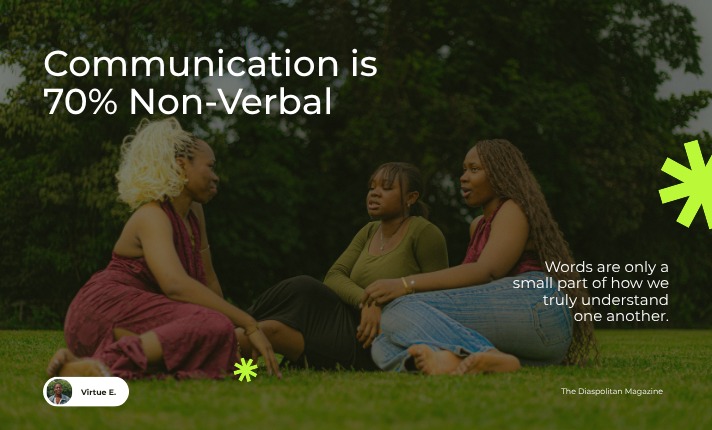
Words are only one part of how human beings understand one another. We often focus on what is said, but much of communication happens before language, beneath language, and sometimes entirely without language. A look, a pause, a gesture, a change in tone, a movement of the body, or even silence can carry meaning more powerfully than a full sentence.
Human communication is not limited to speech. It includes facial expressions, body posture, eye contact, touch, distance, rhythm, silence, tone, and emotional atmosphere. Long before a child learns to say “mama” or “dada,” the child is already participating in a world of signals, responses, and emotional exchanges. In many ways, the human being learns communication first through feeling, observation, and response before mastering words.
The First Classroom
The earliest forms of human connection begin even before birth. Research has shown that unborn babies can respond to certain forms of stimulation, including sound, movement, and maternal touch. When a mother speaks, sings, rests, moves, or touches her belly, the baby may respond through movement or changes in activity. These early exchanges are not language in the formal sense, but they suggest that human connection begins before verbal expression.
In many African, Asian, and Southern cultural traditions, pregnancy is not seen merely as a biological condition. It is also understood as a period of emotional connection between mother and child. The mother’s mood, voice, rhythm, and sense of calm are often believed to shape the baby’s earliest experience of the world. Whether expressed through spiritual language, cultural wisdom, or modern developmental science, the idea is similar: the child begins life inside a field of relationship.
This early bond helps us understand why non-verbal communication is so central to human life. Before we speak, we feel. Before we explain, we respond. Before we name emotions, we sense them.
The Pre-Verbal Brain
After birth, infants continue to communicate through crying, cooing, facial expressions, eye movement, touch, and body gestures. A baby does not need words to express hunger, discomfort, fear, excitement, or the need for closeness. Parents and caregivers gradually learn to read these signals. A particular cry may mean hunger. A restless movement may mean discomfort. A smile may signal recognition and trust.
This exchange forms the foundation of human social development. The child learns that communication is not only about sound but also about attention, response, and emotional presence. The caregiver learns to interpret meaning from small signs. In that relationship, both child and adult become students of the silent language.
Neuroscience has also deepened interest in how human beings understand the emotions and actions of others. The discovery of mirror neurons, first studied in relation to action observation, has encouraged important discussions about imitation, social learning, and empathy. While scientists continue to debate how far mirror neurons explain human empathy, there is broad agreement that human beings are highly responsive to the expressions, movements, and emotional states of others.
This is why laughter can spread through a room. It is why one person’s tears can move another to sadness. It is why a tense atmosphere can be felt before anyone speaks. Human beings do not merely hear one another; they read one another.
The High-Context Home
As people grow, culture shapes how much they depend on words and how much they rely on context. In many high-context cultures, including many African, Asian, Latino, Arab, and Filipino communities, communication often depends less on direct speech and more on shared understanding, relationship, gesture, tone, and situation.
In such cultures, not everything needs to be said openly. Meaning is often carried by the environment, the relationship between people, the timing of a statement, the look on a face, or the silence that follows a question. A child raised in this kind of environment quickly learns that communication is not only about listening to words but also about reading atmosphere.
Many Africans understand the power of “the look” from a mother or elder. No speech is required. A single glance in a crowded room may communicate warning, correction, disappointment, caution, or instruction. The child understands because the message is not in the eye alone; it is in the relationship, the history, the setting, and the shared code between parent and child.
This is not weakness in communication. It is a sophisticated cultural system. It shows that silence can be structured, gestures can be precise, and meaning can be deeply understood without being loudly expressed.
Reading the World Without a Word
Non-verbal communication also shapes everyday public life. On a busy road, a keke driver may know from your posture, your hand movement, or the direction of your gaze that you want to board. In a market, a trader may read your eyes, your hesitation, or the way you touch an item to know whether you are truly interested or merely passing time.
A person in distress may not need to explain everything before others sense pain. A sigh, a lowered head, tired eyes, or a broken voice can communicate suffering before words arrive. Our bodies constantly give information, and other people are constantly interpreting it.
This silent reading is part of survival. It helps us avoid danger, identify welcome, detect hostility, recognise affection, negotiate social spaces, and respond to the needs of others. Every society teaches its members how to read these signs, even if it does not always name the lesson.
In African communities especially, communication is often communal. People learn to observe elders, respect silence, interpret indirect warnings, and recognise emotional shifts in a room. One does not always wait for a formal announcement. The body, the tone, and the atmosphere often speak first.
When Intimacy Reduces the Need for Words
The closer people become, the fewer words they may need. In intimate relationships, families, long friendships, and deeply bonded communities, people develop a shared emotional language. A wife may know her husband is troubled by the way he enters the room. A mother may know her child is hiding something by the rhythm of the child’s voice. Close friends may understand one another through a glance that outsiders cannot decode.
This happens because shared experience creates a private vocabulary. Over time, people who live closely together learn each other’s habits, moods, fears, strengths, and emotional patterns. Their fields of experience begin to overlap. What would be invisible to a stranger becomes obvious to someone who knows them well.
In such relationships, silence is not empty. It may mean comfort, tension, understanding, protest, grief, or peace. The meaning depends on the bond.
This is why the deepest relationships are often not measured by how much people talk, but by how accurately they understand one another when little is said.
Why Words Still Matter
Yet words remain essential. Non-verbal communication is powerful, but it is not always enough. We cannot expect strangers, institutions, cultures, or nations to read our silence accurately. In a complex and globalised world, explicit language helps prevent confusion. It allows us to explain laws, negotiate agreements, teach ideas, write history, express rights, and coordinate action.
Words give structure to feelings. They help us name pain, clarify intention, resolve conflict, and preserve knowledge. Without words, misunderstanding can become too easy. A look may be misread. Silence may be interpreted wrongly. A gesture may mean one thing in one culture and something entirely different in another.
This is why human communication needs both speech and silence. Words help us explain what the heart feels. Non-verbal cues help us sense what words may fail to capture.
The most complete communication happens when both work together.
The Language Beneath Language
Human beings are not only speaking creatures. We are sensing, observing, responding, and interpreting beings. From the earliest bond between mother and child to the silent authority of an elder, from the market trader’s eye to the quiet understanding between lovers, non-verbal communication remains one of the deepest forms of human connection.
It reminds us that communication is not simply the movement of words from one mouth to one ear. It is the movement of meaning between people.
Words may explain us, but silence often reveals us.
Ultimately, we learn to feel before we learn to speak. And even after we master language, we continue to depend on the silent signals that allow us to understand what is unspoken. In a world full of noise, perhaps one of the greatest forms of wisdom is still the ability to listen beyond words.