
If, by some strange accident, I flipped the wrong coin, drowned in the wrong sea, slipped through a portal of time, and found myself standing in 1914, how useful would I be?
Would I remember enough history to warn the Igbo people about the danger ahead? Would I remember to tell the leaders of the Niger Delta that beneath their soil and waters lay liquid gold? Would I tell them to prepare, to own, to negotiate, to drill, to protect what was theirs before foreign companies signed away the future?
Or would I stand there helpless, reaching for a phone that does not exist, unable to open AI, unable to ask where crude oil was first discovered, who controlled it, who profited from it, and who lost the most?
That question may sound dramatic, but it points to something important: artificial intelligence is changing the way we think, remember, learn, and solve problems.
AI cannot replace human intelligence. But it can weaken it if we allow it to do too much of our thinking for us.
This is not an argument against artificial intelligence. Far from it. AI has become one of the most important tools of the modern age. It has improved automation, accelerated data processing, widened access to knowledge, supported innovation, strengthened customer service, improved productivity, and created new possibilities for governance, healthcare, education, finance, telecommunications, and business.
Across Africa, AI adoption is growing rapidly. Reports indicate that African workers are increasingly using AI tools, even at rates higher than some global averages. Major companies have also adopted AI to reduce operational costs, improve service delivery, enhance network performance, and manage large customer bases more efficiently.
This is especially visible in customer service. AI chatbots, virtual assistants, and automated response systems have moved from being optional tools to almost unavoidable features of modern business. Many companies now rely on AI to answer questions, process complaints, guide customers, and provide support at a scale that would have been impossible using traditional human-only systems.
This shift is understandable. A thousand years ago, business was not this complex. There were fewer people to serve, fewer systems to manage, and fewer expectations of instant response. Today, a company serving millions of customers cannot depend only on human agents to handle every complaint, enquiry, and request. For a telecommunications giant with hundreds of millions of subscribers, AI is not just convenient; it is necessary.
In that sense, AI has done more good than harm. It has helped businesses respond faster, reduce waste, and improve access to services.
But artificial intelligence is a double-edged sword. Its advantages are sharp, but so are its risks.
The danger is not that AI will suddenly become more intelligent than humans and replace the human mind. The more immediate danger is that humans may become less willing to use their own minds. AI may not destroy intelligence, but it can dull it.
How?
By taking away the burden of thinking.
The human brain was designed to be used. It grows stronger through effort, repetition, memory, problem-solving, curiosity, and active engagement. When we stop challenging it, it does what all living systems do: it adapts to the lower demand placed on it.
This is where the concept of neuroplasticity becomes important. The brain strengthens the pathways it uses often and weakens the ones it neglects. If we constantly outsource memory, analysis, writing, calculation, research, and decision-making to machines, our ability to perform those tasks independently may decline.
This process is sometimes called cognitive offloading. It happens when we rely on external tools phones, search engines, calculators, GPS, and now AI — to carry mental tasks we once performed ourselves. In moderation, cognitive offloading is useful. It frees the mind for higher-level thinking. But when taken too far, it can weaken memory, concentration, problem-solving, and independent reasoning.
We already see this in everyday life. Many people no longer remember phone numbers because their devices remember for them. Many struggle to navigate without GPS. Students who once memorised formulas, historical dates, periodic tables, and definitions can now ask AI to produce them instantly. Writers can ask AI to draft. Researchers can ask AI to summarise. Workers can ask AI to analyse. Students can ask AI to explain, solve, and even think on their behalf.
At first, this feels like progress. And in many ways, it is.
But what happens when a generation grows up without going through the hard mental processes that sharpen the mind?
Practice builds mastery. Repetition builds speed. Struggle builds depth. Mistakes build understanding. But AI often removes the struggle before learning has fully taken place. It gives the answer without requiring the journey.
That is useful for someone who already understands the process and needs speed. But for someone still learning, it can become dangerous.
Too much accessible knowledge can weaken the hunger for knowledge. When everything is instantly available, the mind may lose the discipline of searching, questioning, remembering, and connecting ideas. We begin to treat information as something to retrieve, use briefly, and delete from memory.
Ask AI. Copy the answer. Use it. Forget it.
That is not learning. That is consumption.
The real concern is not that AI gives us answers. The concern is that we may stop forming our own answers first.
This matters deeply for the coming generation. Young people are growing up in a world where AI can write essays, solve equations, summarise books, generate images, code software, translate languages, and answer questions within seconds. If they are not trained to use AI wisely, they may become highly assisted but intellectually underdeveloped.
A person who uses AI without thinking may appear productive, but may become mentally dependent. The work may be completed, but the mind may not be strengthened.
So what should we do?
We must learn to use AI as a tool, not a replacement. We must treat it as a weapon that can defend or injure, depending on how it is handled.
The first rule is simple: think before asking AI.
Before typing a question into an AI tool, form your own answer first. Even if the answer is rough, incomplete, or wrong, attempt it. Write down what you know. Make your own argument. Solve as much as you can. Then use AI to compare, refine, correct, or expand.
This keeps the brain active. It strengthens recall. It forces engagement. It turns AI into a learning partner rather than a mental substitute.
The second rule is: argue with AI.
Do not treat AI as an oracle. It can be wrong. It can be biased. It can be incomplete. It can sound confident while giving weak information. Challenge it. Ask for counterarguments. Ask what it may have missed. Ask it to critique your position. Ask it to defend the opposite view.
This builds critical thinking, which may be the most important skill in the age of artificial intelligence.
The third rule is: do mental exercises without assistance.
Every now and then, write without AI. Do mental maths. Read long texts without asking for summaries. Explain ideas in your own words. Memorise important facts. Try to solve problems before searching for answers.
This is the intellectual equivalent of going to the gym. If machines lift all the weight for you, your body will not grow stronger. In the same way, if AI does all the thinking, your mind will not grow sharper.
The fourth rule is: use AI for feedback, not replacement.
Let AI review your work, not own it. Let it challenge your ideas, not erase your voice. Let it improve your structure, not replace your understanding. Let it help you become better, not simply faster.
The future will not belong to people who reject AI. It will belong to people who know how to use it without surrendering their minds.
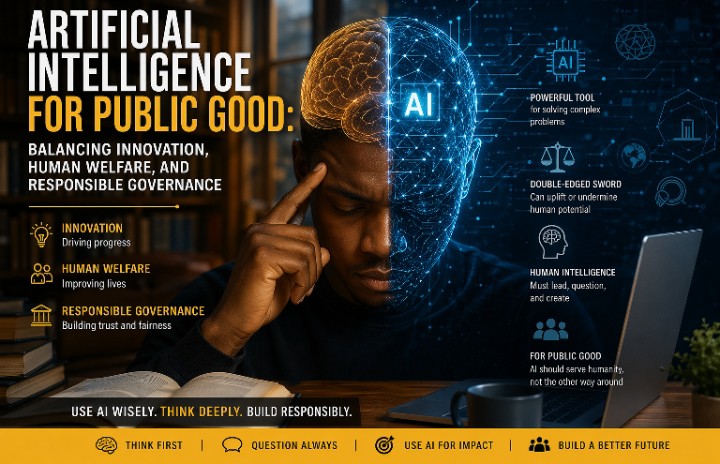
Artificial intelligence can serve the public good. It can improve governance, healthcare, education, business, research, and human welfare. It can help societies solve problems faster and more creatively. But for that to happen, humans must remain intellectually alert.
AI should expand human intelligence, not shrink it. It should support thought, not replace thought. It should help us remember better, learn deeper, and decide more wisely not make us helpless without it.
Because one day, metaphorically or literally, we may find ourselves without the machine.
And when that moment comes, the real question will be: what do we still know? What can we still reason through? What can we still create, remember, defend, and pass on without assistance?
AI is powerful. But the human mind must remain the master.
The task before us is not to fear artificial intelligence. It is to use it wisely with discipline, curiosity, caution, and courage.