
Everything moves. Whether it is people, or goods, or files, or messages - everything moves one way or the other. Because movement is a sign of life. But it does not stop at being a sign of life, efficient movement holds the key to the progress of everything. Everything rises and falls on how fast and efficient movement is - everything.
To solve the problem of sending documents from one place to another without keeping a truckload of papers, storage devices and communication networks were created. Now we have the internet, websites, mobile applications that aid communication. Messages can be sent from one continent to another in a matter of seconds.
Much more than documents, information, goods or files, people need to move. Not just for themselves, but because the economy depends on it. To run local manufacturing and production, workers need to move from their homes to the company consistently. The education sector needs teachers and students to move to and fro seamlessly. The agricultural sector needs to move produce from farm to shops. In general, for the economy to improve, transport has to function efficiently.
When workers spend 50% of their energy on going to work, they have 50% left - productivity is slashed in half. This is why developed countries pay attention to transport management. South Korea has efficient railway systems. Japan has a multimodal rail integration system. Curitiba, Brazil has a structured bus rapid transit system. The Netherlands has an active mobility & cycling superhighway system. Switzerland enabled a sub-surface freight logistics system where they tackled road freight congestion by moving cargo storage and transport completely underground.
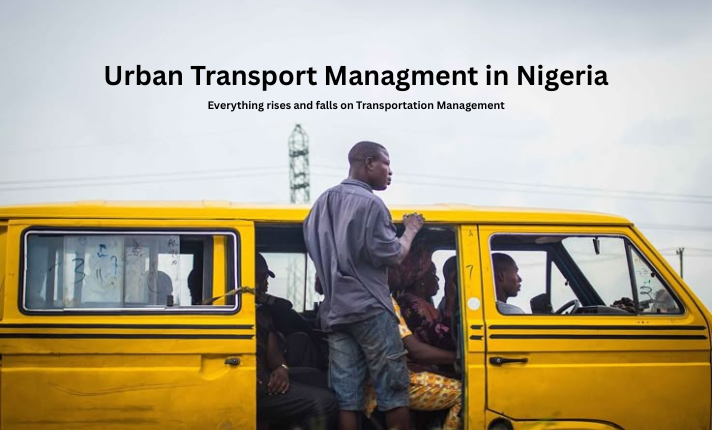
On the other hand, urban transport management in Nigeria is tied in more knots than is made bare on the surface. This is owed largely to the country’s population density. With over 200 million people residing in Nigeria, the road network accounts for over 90% of all passenger and freight traffic- which makes transport management even messier.
Yet, this is not because there are no enough vehicles to transport people. According to baseline data actively used by state transport regulators, there are more than 13 million active vehicles plying Nigerian roads. Approximately 57% to 60% of the active vehicles on major interstate highways are commercial, 38%-40% are registered under private ownership. So why is urban transport management in Nigeria still chaotic?
For better transport management in Nigeria, the clear consensus among urban planners and transport authorities is that we need fewer individual vehicles on the road, but higher-capacity, better-managed transit systems. Private cars and small commercial vehicles (Danfos and Koropes) take up a massive amount of road space while carrying very few people. Meanwhile, one standard Bus Rapid Transit (BRT) bus can carry up to 80 passengers, effectively replacing 50 private cars or 6 Danfo buses on the highway. Hence, handing out private cars to individuals would not solve the transport crisis in Nigeria. It may make transport more convenient for them but it would only lead to more congestion.
So what can be done?
- Rail Sector Modernisation: If the goal is to reduce the number of people on the road, railways are effective in carrying people and heavy goods. A train with multiple coaches can seat up to 1300 people. Hence, creating more railways and redeveloping existing railways would go a long way in making urban transport less chaotic.
- Compressed Natural Gas (CNG) & E-Mobility Transition: Following the removal of the petrol subsidy, we need to shift mass transit reliance away from internal combustion petrol engines to other alternatives that consume less energy. This means we need to start cutting down on petrol vehicles and explore alternatives like electronic vehicles and CNG powered vehicles which are more cost effective and eco-friendly.
- Centralised Regulation Systems: A defining element of Nigeria's road transport is that day-to-day enforcement, hub routing, and micro-taxation are managed by transport unions rather than state agents. The two most powerful transport unions are; the National Union of Road Transport Workers (NURTW) for passenger transit and the National Association of Road Transport Owners (NARTO) for fleet owners and cargo. If transport would ever be managed efficiently and effectively, the government has to take active participation in transport regulations and execution. This would include taking proper records, and implementing policies to maintain civil order and stabilize commuting fares.
What has been done?
- In modernizing the rail sector, the federal government has completed and operationalized key standard-gauge corridors, including the Lagos–Ibadan, Abuja–Kaduna, and Itakpe–Ajaokuta–Warri rail lines. The constitution has been officially amended to remove railway operations from the Exclusive Legislative List to the Concurrent List, legally permitting states and private entities to build and operate rail networks.
- For Compressed Natural Gas (CNG) & E-Mobility Transition, the Presidential CNG Initiative has rolled out structural tax waivers on the importation of CNG conversion kits and electric vehicle components. They have also partnered with downstream energy companies to build active CNG refueling hubs across the country, expanding to over 10 functional stations in Abuja alone. They have also distributed the first waves of newly manu fractured CNG powered passenger buses directly to commercial transport unions (like NURTW and NARTO) to reduce public transport fares.
What is being done?
- Six Geo-Political National Terminals: Allocating ₦142 billion toward constructing six ultra-modern, state-managed national bus terminals across the geo-political zones to eradicate chaotic informal motor parks.
- Lagos Green Line Co-Funding: Injecting ₦102 billion in federal counterpart funding into the upcoming Lagos Green Line Metro Rail (Phase 1) to support sub-national rail density.
Rounding it all up, as we joy in the milestones reached for the development of transport management in Nigeria - with our bags in hand as we struggle for seats in the danfo buses on the busy streets of Lagos, or spend a fortune for Bolt or Uber Rides - we also look forward to the completion of the proposed projects so we can spend lesser energy on the road and more on productive tasks.
Because in the end, everything rises and falls on efficient transport management.